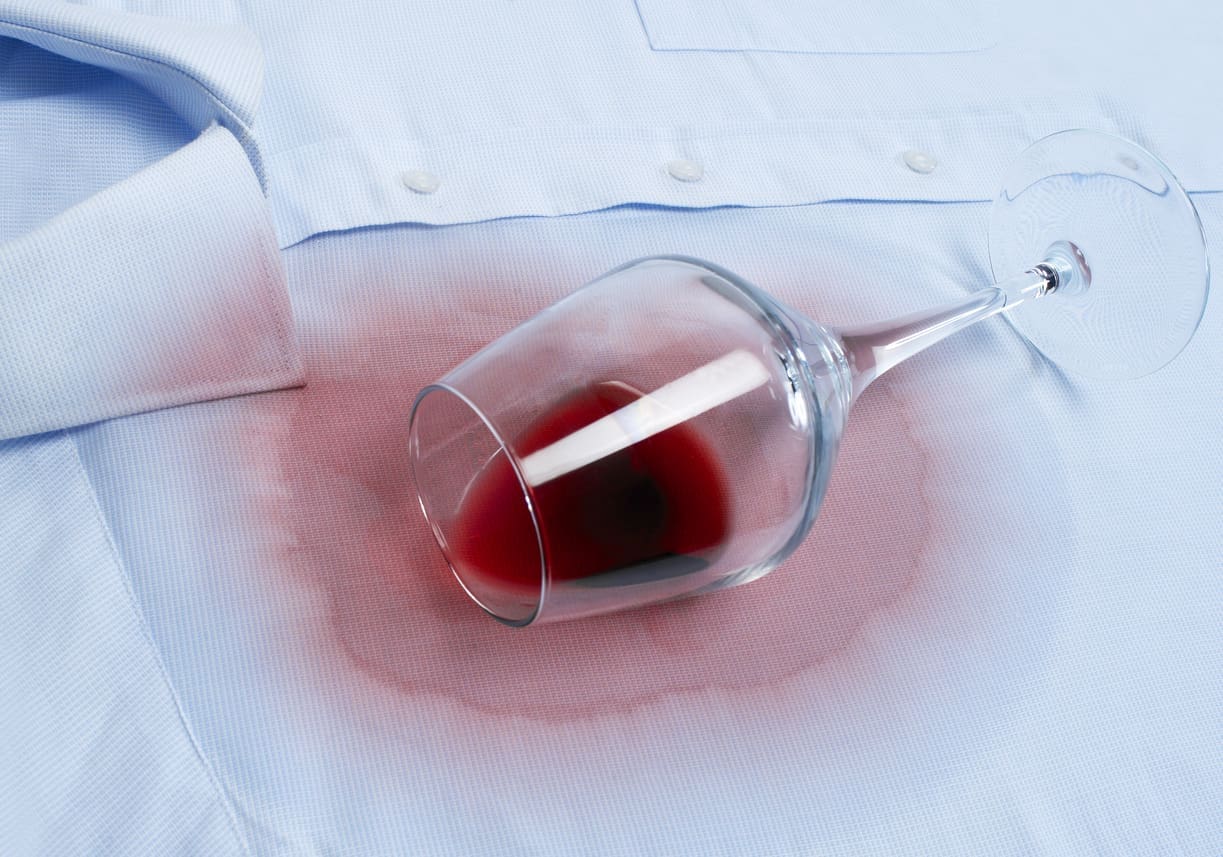
Red wine stains on formal suits don't become permanent because of the wine. They become permanent because of the two minutes immediately after – the rubbing, the water, the salt poured from the table, the napkin wrung across the fabric. Those first responses feel helpful and cause most of the lasting damage.
The wine itself is manageable, even on fine wool. The panicked cleanup is what a dry cleaner has to reverse. Here's what to do instead, in the order you need to do it.
Stop. Do not rub the stain. This is the most common mistake and the one that does the most immediate damage.
Rubbing does two things, both bad:
Blotting lifts out the liquid instead of pushing it around. Here is the correct technique:
Get this right in the first 60 seconds and your odds of full removal improve dramatically.
If you are near a bar or a sink, club soda or plain cold water can help dilute the wine before the tannins bond to the fabric. Apply with a cloth, not by pouring directly. A small amount goes a long way.
Do not use salt. This tip circulates constantly and it is consistently wrong for suits. Salt draws the stain outward on wool and structured fabrics. It can also stiffen the material and leave behind discoloration.
On a linen tablecloth, it has some logic. On a tailored suit jacket, it makes things worse. Leave it on the table.
The internet has no shortage of DIY stain removal advice. But almost none of it was written with structured wool suiting in mind.
Any of these applied before professional assessment does not just risk not working. It can chemically alter the fabric in ways that make professional removal harder or impossible.
A structured jacket is built around a canvas interlining that gives it shape at the chest, lapels, and shoulders. Water and machine agitation collapse that structure permanently. The jacket may be technically stain free after a wash, but it will never sit, drape, or hold its shape the same way.
Heat sets the stain. Steaming drives both heat and moisture into the fiber simultaneously. A stain a dry cleaner could have treated becomes significantly harder to address after this.
Red wine stains are tannin stains. Tannins are plant-based compounds that bond aggressively to protein fibers, and wool is a protein fiber. This is why red wine on a suit behaves differently than on a cotton shirt.
Professional dry cleaners use tannin-specific pretreatment agents, either enzyme-based or solvent-based, calibrated for the fabric type and the age of the stain. This is not a stronger version of what you find under your kitchen sink. The chemistry is genuinely different. These solvents break down the tannin bond at the fiber level, something no home product replicates.
Here is an honest breakdown based on stain age:
A cleaner who tells you every stain is guaranteed to come out tells you what you want to hear. A cleaner who factors in age and prior treatment tells you how it actually works.
Take in the suit within 24 hours. That window is when recovery rates are highest and treatment options are widest.
When you drop it off, give the cleaner the full picture. The more information they have, the better the outcome:
This information directly shapes the pretreatment approach. A cleaner working with context will make better decisions than one guessing from a dry, set stain with no history.
You don't want one accident to damage an expensive formal suit, do you? Cadillac Cleaners provides expert stain evaluation, fabric-specific treatment, and convenient Pickup and Delivery Service, so your clothes are handled with care from the moment you hand them over.
Accidents happen, but they don't have to leave a lasting mark. Schedule a Pickup and Delivery Service today and let us restore your suit.
Contact Details: