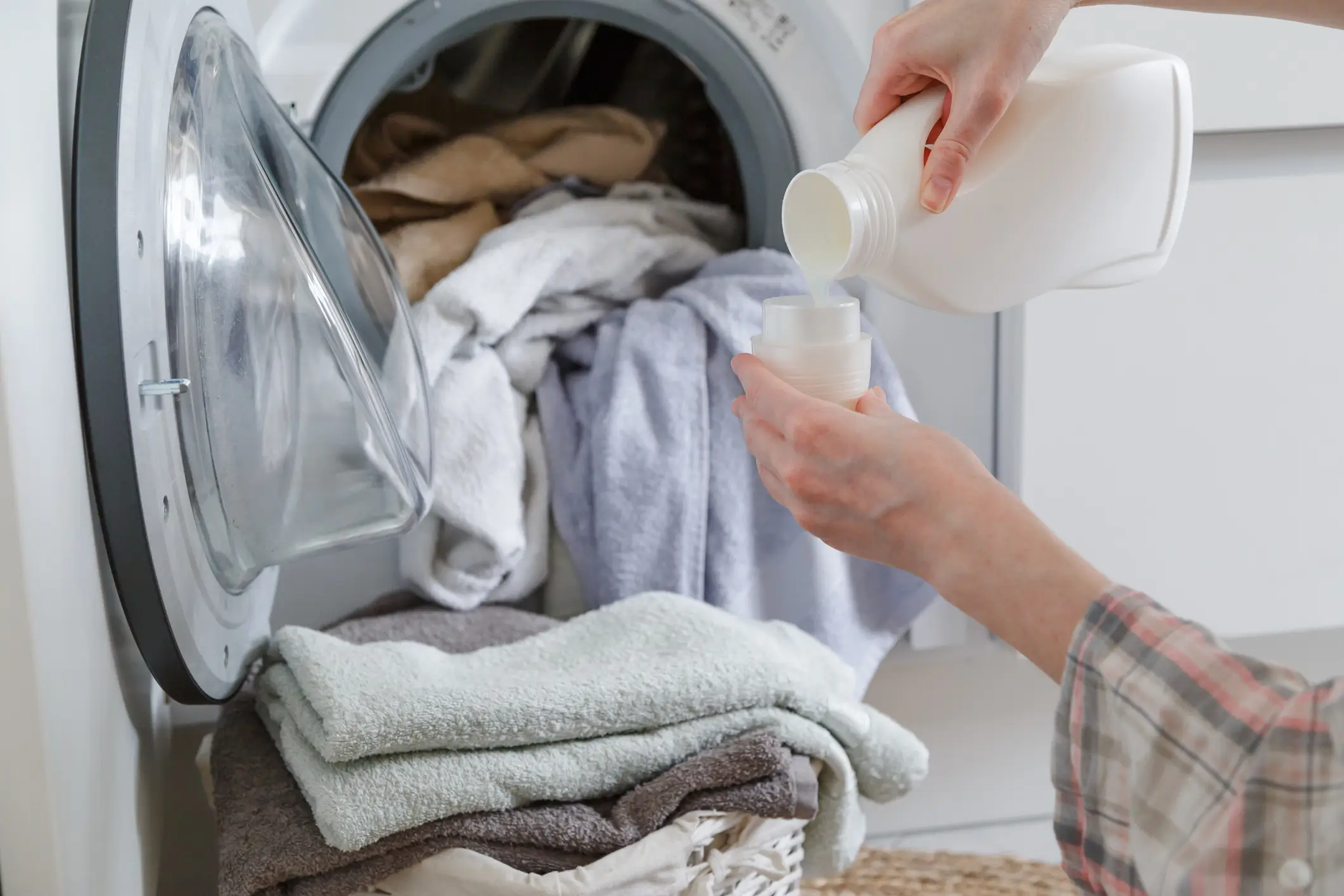
If your laundry routine has started leaving towels stiff, darks looking chalky, or streaks on clothes straight out of the dryer, you're not doing anything wrong exactly; you're just using too much detergent. That one habit explains all three problems at once.
Detergent is made up of surfactants, builders, brighteners, enzymes, and fragrance carriers, and every one of those components rinses out at its own rate. A wash cycle is only designed to flush away a set amount. Once you go over that amount, the extra has nowhere to go but back onto your clothes, your machine, or your skin.
Leftover detergent has exactly three places to go once the rinse cycle finishes: into the fabric, into the machine itself, and onto your skin. Most people only ever notice the first one, which is why the other two get blamed on everything except their real cause.
Knowing all three at once is what turns something that feels off with your laundry into something you can actually fix, instead of guessing at one symptom while the other two keep building.
A rinse cycle is built to remove a specific, expected amount of detergent, calculated for an average load at the recommended dose. It isn't designed to flush out double or triple that amount. Excess suds also work against the machine here: foam cushions the fabric instead of letting water move through it freely, so the extra detergent you added to clean better actually reduces how much water contact your clothes receive.
This is the destination most people already sense, even if they can't name why. Residue sits across the surface of each fiber, and that thin film changes how fabric looks, feels, and performs. This causes:
That last point explains a lot. Anything whose job is soaking up or moving water – towels, cloth diapers, workout gear – takes the worst of it.
Run your hand across a towel that's stopped absorbing well, and you feel a residue film sitting across the cotton loops, pushing water away instead of drawing it in. The natural response is to add more fabric softener to soften the texture, but the softener adds its own coating on top of the one already there. Each round makes the towel less absorbent, not more, which is why some people end up with towels that barely dry anything despite using more product every wash.
If you see actual white streaks, powdery marks, or crusty spots on finished laundry, that's a different issue from the film described above. Streaks and spots are usually undissolved detergent that never fully dissolved into the wash water in the first place, not residue that rinsed and re-settled.
This shows up more often under specific conditions:
The fix matches the cause: Use the dispenser drawer, switch to liquid or pods if you consistently wash cold, and give the machine room to actually tumble the load instead of packing it tight.
The combination is worse than either factor alone. Powder detergent needs both warmth and agitation to dissolve fully, so a cold wash in an overstuffed drum gives it neither. If you wash cold by habit or by fabric requirement, switching to liquid detergent solves this specific streaking issue without changing anything else about your routine.
This is the destination almost nobody thinks about, and it explains a complaint that seems unrelated: a machine that smells musty no matter how often you run it.
Residue doesn't just rinse down the drain. It clings to the drum, the door gasket, the dispenser tray, and the drain path, holding moisture that feeds the buildup behind that odor. Over time, it can also slow drainage and, on newer machines, throw off load or water-level sensors.
Once your machine holds residue, it doesn't just sit there. Every new load passes through that same drum and gasket, picking up a small amount of what's already built up before the wash even starts. That's why some households keep smelling the same musty note no matter how new the detergent or how hot the wash: the source has moved from the clothes to the machine, and the machine keeps reintroducing it.
Fabric that carries residue is in contact with your skin for hours at a stretch. For some people, particularly children and anyone with sensitive or eczema-prone skin, that steady contact shows up as itching or irritation with no obvious trigger.
This isn't a diagnosis, and it shouldn't be treated like one. It's worth ruling out as a contributing factor before assuming it's something else entirely.
Rather than guessing, try this: cut your detergent dose in half and add a second rinse cycle for two weeks, then see if anything changes. It's a low-cost way to find out if residue is playing a role, without changing anything else about your routine. If irritation is persistent or getting worse regardless, that's a conversation for a doctor, not a laundry adjustment.
Most dosing caps are marked generously, and most washing machines, especially newer high-efficiency models, need far less than what the cap line suggests. A reasonable starting point for a normal load is roughly half the cap's recommended amount.
From there, four things push the right amount up or down:
Change one of these at a time rather than guessing at a whole new routine, so you can actually tell which adjustment made the difference.
It's easy to assume harder water problems get solved with more detergent across the board, but the opposite is true for soft water. Soft water already lets detergent work more efficiently, so using the same dose you'd use for hard water leaves you with more unrinsed product than a soft-water wash can carry away. If you're on a municipal soft water supply or use a water softener, this is often the single biggest reason residue keeps showing up despite following the instructions.
Dialing in the right dose going forward won't undo what's already built up in fabric you currently wear or the machine you currently use. Both need a reset.
For fabric already carrying residue:
For the machine itself:
Set your expectations honestly here. Heavy buildup usually takes two or three passes to clear, not one, and towels that have carried years of residue may improve significantly without ever fully returning to their original absorbency.
It's easy to strip your towels and stop there, but if the machine itself is still holding residue, everything you wash afterwards starts to pick it back up. Doing both fabric and machine resets together in the same week actually breaks the cycle, instead of just delaying the next round of stiff towels.
Getting your detergent dose right and stripping out old buildup fixes the problem, but towels and bedding carrying years of accumulated residue often need more than a home machine can actually give them.
At Cadillac Cleaners, our Wash and Fold Laundry Service in Bartlesville, Oklahoma handles exactly this kind of reset for towels and bedding that never fully recovered no matter how carefully you've stripped them at home.
When you're ready to clear years of buildup at once, drop off your towels and bedding at the store or schedule a Pickup and Delivery Service this week.
Address: 2525 SE Washington Blvd, Bartlesville, OK 74006
Phone: +1 918-333-5800
Email: info@cadillac-cleaners.com